The ECO-CATCH team spotlight series shines a light on the personalities and expertise behind the project. In our first installment we spoke to project coordinator Valentina Melli.
Full name: Valentina Melli
Current job title and Institution: Senior Researcher in Fisheries Technologies Section, DTU Aqua
Role within ECO-CATCH: Project Coordinator
What does your role within ECO-CATCH involve?
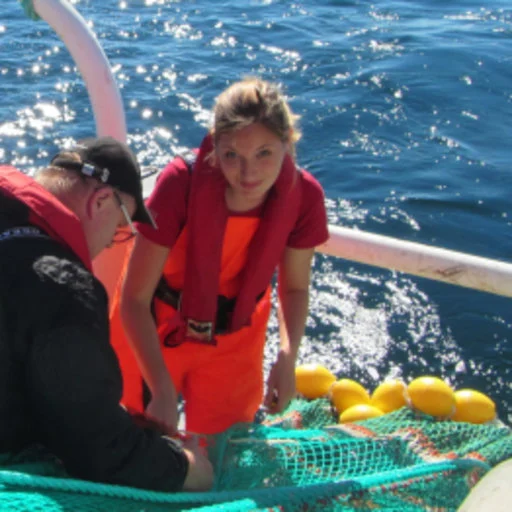
As ECO-CATCH project coordinator, alongside Lotte Kindt-Larsen, I work closely with the full consortium to ensure we stay true to our mission to develop and ensure the commercial viability of new fishing technologies to minimise bycatch of Endangered, Threatened and Protected (ETP) species and juvenile fish in the Baltic and North Seas. I am always on the lookout to make new connections with other projects and organisations to create synergies across sectors and basins.
What is your background and journey to ECO-CATCH?
My journey into fisheries began with a documentary called ‘The End of the Line’ which warned about the unregulated exploitation of fish stocks, potentially leading to a future without fish. At the time, I was studying for my Masters in Marine Biodiversity Conservation and Management in Italy, and the documentary inspired me to pursue more applied sciences that develop solutions rather than documenting problems.
Indeed, if there’s one thing you should know about me, it’s that I love solving problems. I entered this field through my master’s thesis on artisanal trap fisheries targeting cuttlefish, where I was tasked with finding a practical way to protect eggs laid on the surfaces of these traps. That experience gave me a first glimpse into the challenges faced by fishers and how rewarding it is to work together towards a solution.
After my thesis, I wanted to learn more about the specific challenges facing different fisheries, so I became a fishery observer and for the next four years I monitored bycatch of ETP species, as well as commercial and discard fractions. I was out 2-3 times per week, becoming a contact point for local fishers and providing training to them on best handling and release of ETP species.
After four years, I had a much deeper understanding of the challenges fisheries were facing but I wasn’t contributing to any solutions, so I packed my very Italian car (a Fiat Punto) and drove north to Denmark to become an Engineer with a PhD in Fisheries Technologies.
How did ECO-CATCH start?
We have a long history of fisheries innovation and close collaboration with the industry in our basin, but this has often been tempered by frustration over limited uptake and the long, winding path to implementation. Moreover, ETP species and commercial catches are typically handled by separate groups of experts and stakeholders. With ECO-CATCH, Lotte and I could bring together our expertise and build a strong network of partners with the knowledge and skills to address the challenges of both ETP and juvenile fish bycatch – now at the heart of ECO-CATCH’s mission.
Why is targeting bycatch reduction and achieving ECO-CATCH’s goals important to you?
There is a lot of scientific evidence that sustainable fisheries can be a low-carbon footprint source of proteins, and given the current political instability food security is becoming more and more relevant in the EU. Moreover, by improving and managing well our local fisheries rather than rely on imports we have the chance to support coastal communities and set the standard for sustainable seafood in EU.
Which aspects of ECO-CATCH’s work interest you most and why?
As Project Coordinator, everything ECO-CATCH is close to my heart and I really strive to see our efforts come through and make a real change in our basin.
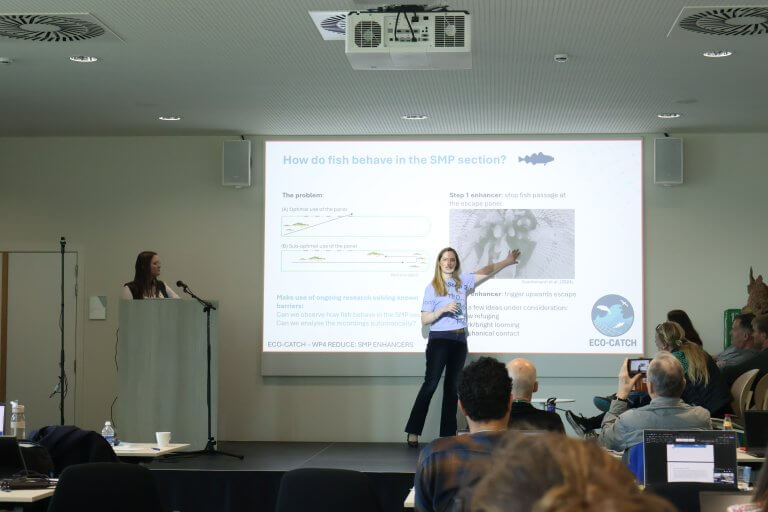
I also contribute to some of the science within ECO-CATCH, on efforts aimed at reducing bycatch of sensitive Atlantic cod and juvenile fish in demersal trawl fisheries by improving the performance of escape panels. Escape panels are among the most widely used bycatch reduction devices (BRDs) in our region, as they are cost-effective, safe, and easy to maintain. However, their effectiveness depends heavily on species-specific behaviour and the ability of fish to take advantage of them to escape the trawl, which can limit their overall performance. Together with my colleagues, Senior Researcher Junita Karlsen and postdoctoral researcher Alexa Abangan, we seek to better understand fish behaviour within the trawl and identify ways to stimulate interactions that enhance escape. Because these BRDs are widely used in fisheries, even incremental improvements have the potential to significantly reduce bycatch across multiple fisheries.
How do you think your work in ECO-CATCH will help reduce bycatch and achieve sustainable fisheries in the Baltic and North Seas?
A large portion of my work goes into promoting the work we are doing and creating synergies with other projects. I don’t want ECO-CATCH’s innovations to be added to a list and quickly forgotten – I want to see them in use. And for this to happen, it is essential we demonstrate consistent performance, scalability and transferability across vessels and fisheries. I am constantly on the lookout to find these opportunities for the partners and stakeholders involved in ECO-CATCH.
Which areas of ECO-CATCH’s work are you most excited by? Where do you see hope for achieving change?
I am very proud of the passionate and expert team we have built for ECO-CATCH. From the 5 Research Institutes, to the SMEs and Fish Producers Organisation, and the Certification and Sustainability Ranking schemes we have onboard our team, everyone is working together to achieve a real and lasting change in the basin. I am most excited to see all these expertise come together to deliver commercial-ready innovations that outlive the project and improve the sustainability of fisheries in the Baltic and North Sea.
Find out more about Valentina’s research and explore her publications here.
Contact us:
info@eco-catch.eu
Follow us: