
A new multi-stakeholder project, ECO-CATCH has launched to transform the future of fishing in the Baltic and North Sea that will empower fishers in their efforts to reduce environmental impact and boost value.
Funded by the European Climate, Infrastructure and Environment Executive Agency (CINEA), ECO-CATCH brings together leading scientists, industry innovators, and certification bodies. Our aim is to turn 10 promising innovations for protecting habitats and minimizing bycatch of juvenile fishes and Endangered, Threatened, and Protected species into ready-to-use products made to enhance the sustainability of fleets and their access to premium seafood markets. Focusing on the Baltic and North Sea, and alongside two sister projects for the Arctic–Atlantic and Mediterranean, ECO-CATCH will play a key part in helping both marine ecosystems and fisheries in Europe to thrive.
Key highlights
From Innovation to Industry and Policy Adoption
During an R&D phase of 3.5 years, ECO-CATCH will mature 10 promising technologies to commercial readiness. Collectively, these technologies will boost the ability of fleets to avoid vulnerable habitats and areas of high bycatch risk, and provide more selective or alternative gear to minimize the capture of juvenile fish such as cod and Endangered, Threatened, and Protected (ETP) species such as porpoises. This includes wheelhouse visualizers to guide skippers to areas where they can fish efficiently without damaging habitat or catching non-target species, modifying trawls to make them easier for cod to escape from, progressing the new “MicroSeine” gear for small-scale demersal fishers, and developing alternative gear such as seal-proof pots.
The last phase of the project will focus on demonstrating the viability of these technologies in commercial fishing conditions, addressing legal and social barriers to their adoption, and enabling them to be recognized in certification assessments. Connecting the innovations to market advantages will reward fisheries for their sustainability efforts and showcase these to the public. In parallel, the consortium’s strong track record in government advisory work will enable project outputs to feed into long-term policy and industry standards.
“ECO-CATCH is about turning scientific innovation into real-world solutions for Europe’s seas, fishers, and communities. By working across the value chain, we can deliver technologies and business models that make sustainable fishing the new standard,” commented Dr. Valentina Melli, one of the project’s coordinators.
A Leading Role for Fishers
Fishers are vital to the efforts of ECO-CATCH and other initiatives. They can be sentinels of the sea, able to spot and flag changes to the environment and populations of fish and other marine animals; and they can play a leading role in developing, trialing, and adopting innovations. These low-impact fishing technologies are urgently needed for nature and people and will only be possible through collaboration between the fishing industry, researchers, seafood businesses, certification schemes, and policymakers. Such innovations will contribute to a future in which both coastal fishing communities and marine ecosystems are resilient and capable of flourishing.
ECO-CATCH member the European Association of Fish Producers Organisations (EAOP) said: “Finding realistic, durable, and effective solutions to mitigate bycatch of protected species or undersized fish is in the key interest of fishers in Europe. That is why the EAPO is happy to be involved in ECO-CATCH, where we will be leading the practical demonstration work of bycatch solutions in different fisheries with a focus on technical, economic, social and legal aspects. With our large network of fish producer organizations, we hope to mobilize a substantial number of active fishers to participate in ECO-CATCH’s bycatch mitigation.”
A Dynamic Project Launch with Partners Across the Fisheries Value Chain
ECO-CATCH unites expertise from across the European fisheries value chain, including research and development institutions, small to medium companies, fish producer associations, seafood suppliers, and certification labels. Alongside the Technical University of Denmark, partners include the Institute of Marine Research (Norway), the Flanders Research Institute for Agriculture, Fisheries and Food (Belgium), the Johann Heinrich von Thünen Institute (Germany), the Swedish University of Agricultural Sciences, Anchor Lab (Denmark), Espersen (Denmark), Egursund Group (Norway), the Electronic Fish Information Centre Europe (the Netherlands), Atlas Maridan (Denmark), the Marine Stewardship Council (UK), the International Seafood Consulting Group (Finland), the Good Fish Guide (Luxembourg), the European Association of Fish Producers Organisations (Belgium) and Mindfully Wired (UK).
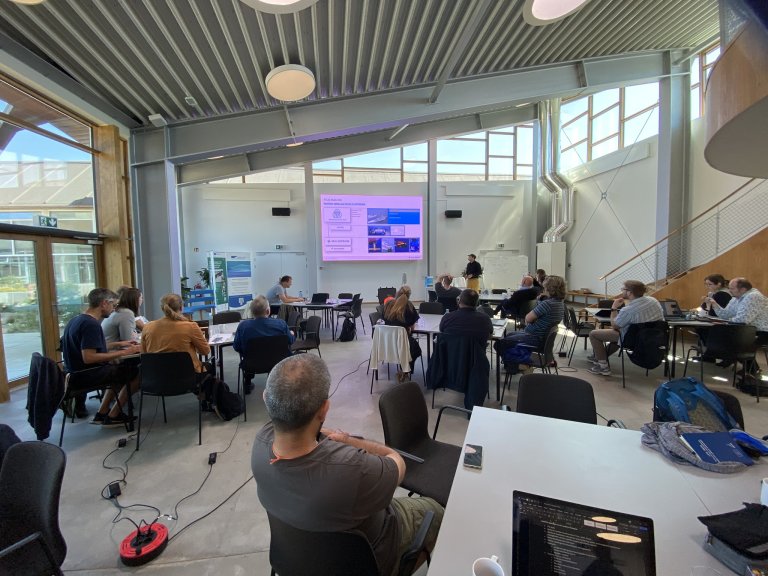
Over three days in late June, team members from across the consortium converged on DTU Aqua’s Hirtshals Campus for the kick-off meeting to make and strengthen connections, discuss the project’s objectives and ambitions, horizon-scan for opportunities and challenges, and prepare for the months and years of fruitful work to come. Reflecting on the kick-off meeting, Dr. Lotte Kindt-Larsen, the project’s other coordinator, said: “It was amazing having the partners together in the same room and sharing their wishes for change and collaboration. Everyone is making the effort and positive engagement to make ECO-CATCH fly!”
Combining Efforts to Optimize Impact
Just as ECO-CATCH is working to protect habitats and biodiversity in the North Sea and Baltic Sea, two new sister projects including other key actors in the seafood supply chain will focus on the same goals elsewhere in Europe. MarineGuardian, led by Jónas R. Viðarsson at MATIS in Iceland, will work with fisheries in the Arctic-Atlantic. Details of the Mediterranean project will be announced soon.
ECO-CATCH and its sister projects will also work closely with existing EU LIFE-funded ones CIBBRiNA, Marine Beacon, and REDUCE, which all focus on minimizing and where possible eliminating the bycatch of ETP species across European waters. The bycatch “cluster” of all six projects will super-charge the synthesis of their outputs and the embedding of collaborative and innovative approaches to fisheries sustainability that have fishers at their core.
Women’s Leadership
ECO-CATCH is coordinated by researchers Dr. Valentina Melli and Dr. Lotte Kindt-Larsen, two of 11 large EU project coordinators at DTU Aqua. Their success marks a milestone for gender equity at the institution, lowering the average age of first-time female coordinators to 43.6 years (compared to 49 years for males).
Dr. Melli started out as a fisheries observer in the Mediterranean Sea, where she acquired extensive knowledge of fishing dynamics and bycatch issues across fishing methods, as well as a deep understanding of the challenges of working at sea and being a fisher. After moving to Denmark, she put this experience into use by specializing in the development of practical gear modifications that reduce bycatch of juvenile fish and sensitive fish species while maintaining target catches. Likewise, Dr. Kindt-Larsen has from the beginning of her career focused on interactions between fisheries and ETP species. Her specific avenues of research include bycatch monitoring with video systems, bycatch risk predictions, bycatch reduction tools such as acoustic deterrent devices, and development of alternative fishing gears to minimize the taking of fishers’ catches by marine predators.
Contact us:
info@eco-catch.eu
Follow us: